ICT solutions’ integration in farms [Student]
Introduction
In the future European farmers will have to effectively manage information on and off their farms to improve economic viability and to reduce environmental impact. All three levels, in which agricultural activities need to be harmonized with economical and environmental constraints, require integrated ICT adoption:
- improvement of farm efficiency;
- integration of public goods provided by farming into management strategies;
- relating to the environmental and cultural diversity of Europe’s agriculture by addressing the region-farm interaction.
In addition, the communication between agriculture and other sectors needs improvement. Crop products for the value added chains must show their provenance through a transparent and certified management strategy and farmers receiving subsidies are requested to respect the environment through compliance of standards. To this end, an integration of information systems is needed to advise managers of formal instructions, recommended guidelines and implications resulting from different scenarios at the point of decision making during the crop cycle. This will help directly with making better decisions as the manager will be helped to be compliant at the point and time of decision making.
Related Project
In FUTUREFARM the appropriate tools and technologies were conceptually designed, prototypes developed and evaluated under practical conditions. Precision Farming as well as robotics are very data intensive and provide a wealth of information that helps to improve crop management and documentation. Based on these technologies a new Farm Information Management Systems (FMIS) was developed. As most relevant farm data are readily available in the proposed information system, or may be automatically integrated using standardized services and documentation in the form of instructions to operators, the certification of crop production process and cross compliance of standards can be generated more easily than with present systems. [1]

General aims:
Although most people can see the benefits of using a more precise approach to manage crops with additional information, the tools provided by precision farming and other information technologies have not yet moved into mainstream agricultural management. The increased complexity of the systems inhibits easy adoption and makes calculations as to the financial benefits uncertain. These issues can be resolved by improving the decision making process though better management information systems, improved data interchange standards and clear management methods.
Therefore the collaborative project FUTUREFARM defined the following objectives as relevant and worked on delivering them:
Objective one: Vision of new knowledge based biological, technical, social and economic innovations.
Objective two: Cost efficient compliance with standards as an integral part of farm operations.
Objective three: Special requirements for high value markets, sharing good farming practices, recognition and communication of ecological and cultural diversity as well as regional demands on multifunctional production of non-commodities.
Objective four: Integrated technologies and ICT tools to make cost efficient compliance with standards an integral part of farm operations.
Objective five: Understanding of overall trends of European societies, new models of relationships with consumers and citizens, rural economy, the multifunctional European farming model delivering public goods.
Objective six: New models of material flow management, based on information and knowledge management supporting on-farm or local integration of environmentally friendly closed loop processing facilities, energy efficient cultivation with light machinery, precision farming and robotics.
Objective seven: Generalisation of project results and demonstration of all of the above points and showing its feasibility for many future farms in the EU.[2]
Related Smart Farming Technology Product
SAR 4.0 is a mobile autonomous system based on Open Source platform. Several image processing methods produce information that is translated into navigation decisions and actions for robot. The potential of SAR 4.0 is a modular Vehicular platform with several skills on Precision Agriculture as Mobile Monitoring & Sprayer Robot and Autonomous Harvest Robot. Transmission via Fuel or Electric batteries, RTK Positioning and image processing are the main features of this powerful farming tool. [3]
Learn more:
Related Scientific Article on autonomous vehicles in farms
A distributed control framework for motion coordination of teams of autonomous agricultural vehicles[4]
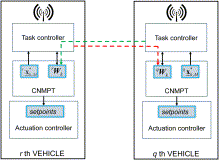
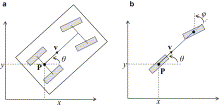
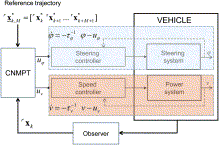
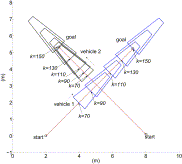
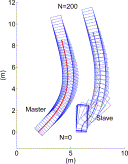
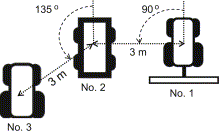
A distributed control framework intended to coordinate the motions of teams of autonomous agricultural vehicles operating in proximity is presented; master-slave and peer-to-peer operation modes are supported. Each vehicle has a nonlinear model predictive tracking controller, which keeps it as close as possible to the path demanded by the task, and coordinates and avoids collisions with nearby vehicles. To do this, it receives the motion trajectories of all other vehicles in its vicinity that may interfere with its own projected motion via a wireless network, and incorporates these trajectories in the computation of its own optimal control action. Each controller is supervised by a higher-level task controller that determines a limited set of the controller’s parameters. Simulation experiments have shown that the minimisation of the tracking error along a finite horizon enabled the controller to track paths containing sharp turns, by applying appropriate steering well in advance of the turn. It has also been shown that the variation of specific predictive controller parameters results in a wide range of behaviours; i.e., vehicles can move in both operating modes, coordinate with nearby vehicles by altering their velocity profiles or the shapes of their paths, and avoid collisions.
 |  |  |  |  |  |
|---|
References
[2] https://cordis.europa.eu/project/rcn/88262/reporting/en
[4] Stavros G. Vougioukas (2012), A distributed control framework for motion coordination of teams of autonomous agricultural vehicles. Biosystems Engineering, Volume 113, Issue 3, Pages 284 297, ISSN 1537-5110.