
Autonomous Agricultural Robots [Farmer]
Introduction
Agricultural robots are generally designed to execute a agricultural task such as planting, weeding, pruning, picking, harvesting, packing, handling etc. Agricultural robots automate specific slow, repetitive and dull agricultural tasks for farmers, drastically limiting hard labor and allowing the producers to focus more on improving overall production yields instead of spending most of their time in the fields. Some of the most common robots in agriculture are used for automated harvesting and picking, weed control, mowing, pruning, seeding, spraying and thinning, sorting and packing. Out of them, harvesting and picking are the most popular robotic applications in agriculture due to the accuracy and speed that robots can achieve to improve the size of yields and reduce waste from crops being left in the field.[1]
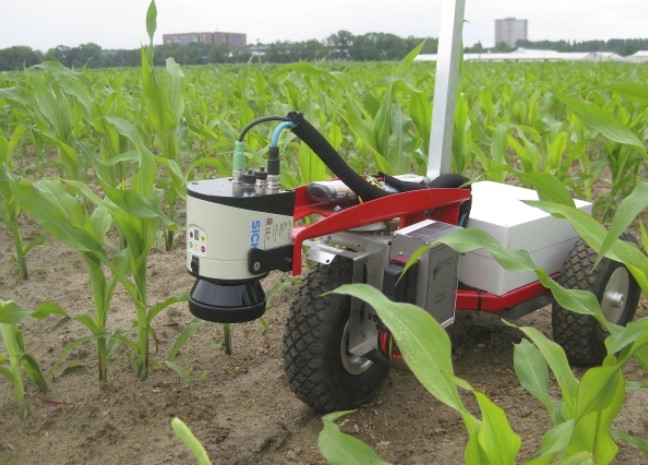
The ability of autonomous robots to detect weeds from cultivated crops quickly and efficiently has established automated weed control as a key-sector of agricultural robotics.
Related Smart Farming Technologies
Weeding Robots
BoniRob[3]
BoniRob is a multi-purpose robotic platform for applications in agriculture. The robot is capable of distinguishing between weeds and crops by comparing them to images using machine learning. These include a number of factors for the analysis, such as leaf color, shape, and size. Bonirob can then eliminate unwanted weeds by ramming in the ground. At the same time, its four independently steerable drive wheels and the ability to adjust its trackwidth make it highly maneuverable in fields.
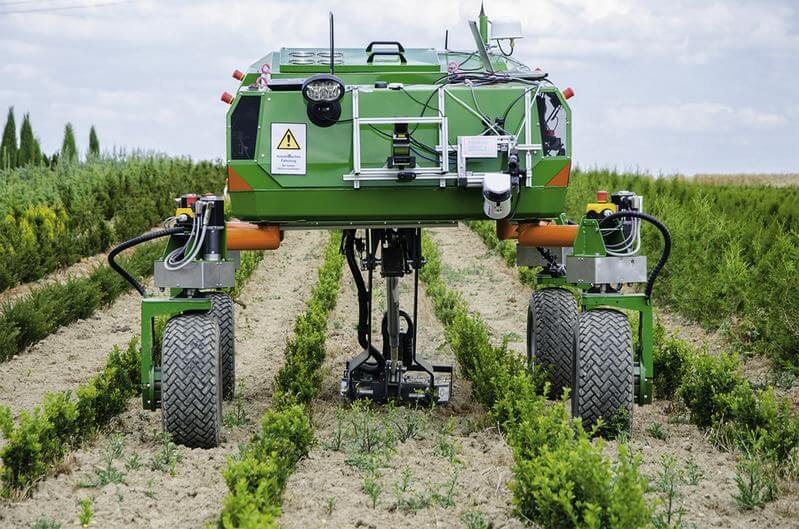
The robot works without being controlled by a human operator. It covers the ground just by getting its bearings and positioning itself with the help of its camera, GPS RTK and sensors. Its system of vision enables it to follow crop rows, and to detect the presence and position of weeds in and between the rows. Two robotic arms then apply a microdose of herbicide, systematically targeting the weeds that have been detected.
Reliance on solar power makes the robot completely autonomous in terms of energy, even when the weather is overcast. As it adapts its speed to the concentration of weeds, it is most suitable for use in fields where the level of concentration is low to moderate, in order to cover the ground at a reasonable speed. We recommend using the machine after an initial standard application of herbicide, in order to replace subsequent applications and thus save an important amount of herbicide. The machine can be completely controlled and configured by means of a Smartphone app.
Harvesting Robots
AI-equipped Tomato Harvesting Robot[5]
This robot moves along a rail that is laid between the tomato seedling rows to harvest the tomatoes. The robot is equipped with a camera that has an image recognition function. It uses this to find the tomatoes and determine whether they should be harvested or not.
Sweeper – Sweet Pepper Harvesting Robot
The Sweeper Robot was created as part of the EU project and is an all-in-one sweet pepper harvesting robot. The aim of the project was to develop a robotic harvesting solution for sweet pepper under real-world conditions.
References
[1] Agricultural Robotics: Opportunities, Challenges and Perspectives
[2] Autonomously navigated crop robot using a SICK LMS111 laser scanner
[3] BoniRob
[4] Ecorobotix Autonomous Robot Weeder