Improved GNSS ground-based augmentation systems [Professional]
Introduction
Improved GNSS ground-based augmentation systems can enable cost-effective precision agriculture services to farmers, especially those with small and medium-sized businesses in areas of Europe where EGNOS availability may be poor under certain conditions. In several areas of Eastern and South Europe GPS accuracy is much less than the standard provided by existing augmentation services. This technology offers better accuracy with faster convergence times.
- The sector’s market value is estimated to roughly reach 180 €m in 2023, composed by c. 300 k GNSS devices by that year in Europe.
- PA is put at approximately 80% of the commercial market from UAVS in USA (2014-2024)
Related Project
The goal of AUDITOR project is the implementation of novel precise-positioning techniques based on augmentation data in custom GNSS receivers can improve the performance of current augmentation services and reduce costs. More sophisticated atmospheric models will be implemented to provide better corrections of ionospheric errors and further increase accuracy. All these advances will be integrated in a software demonstrator that will use public data from GNSS networks to generate these correction data streams. These new receivers will enable cost-effective precision agriculture services to farmers, especially those with small and medium-sized businesses in areas of Europe.
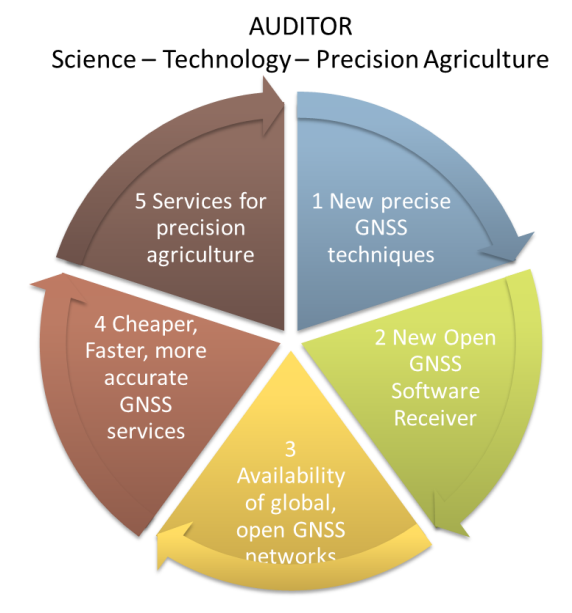
The custom dual-frequency receiver module will follow an innovative approach by porting a GNSS software-defined receiver to an embedded system that will integrate hardware accelerators to enable real-time operation in a low power system. The form factor and capabilities of the resulting receiver will be comparable to those of existing professional receivers in the market, while retaining all the advantages of software receivers: modularity, scalability, upgradability, and flexibility. Besides providing multi-frequency multi-constellation support, this advanced receiver will allow very low level access to key internals even at sample level, enabling the integration of other complementary techniques like interference analysis and monitoring or authentication using remote servers for encrypted bands. The fact that the software layer will be the evolution of an existing and successful open-source project, GNSS-SDR, will allow GNSS developers and researchers to customize the code of the receiver to tailor it to their own applications or test their algorithms using this flexible receiver module, from reflectometry to ultra-tight coupled GNSS/INS systems.[1]


References
[1] draxis.gr/projects/auditor
[2] cordis.europa.eu/project/rcn/199301/reporting/en