Variable Rate Fertilization [Farmer]
Introduction
Applying fertilizer is a common agricultural activity that can be completely automated with the correct implementation of Variable Rate Fertilization (VRF). There are two main categories in which VRT fertilization can be applied: 1) with a map of a certain parameter such as crop vigor and 2) with real time sensors.
VRA increases your economic return by strategically optimizing inputs in each management zone. VRA allows you to focus inputs on management zones that provide the highest return, while reducing inputs in lower productivity zones or where previous management has resulted in a situation for reduced input need.[1]
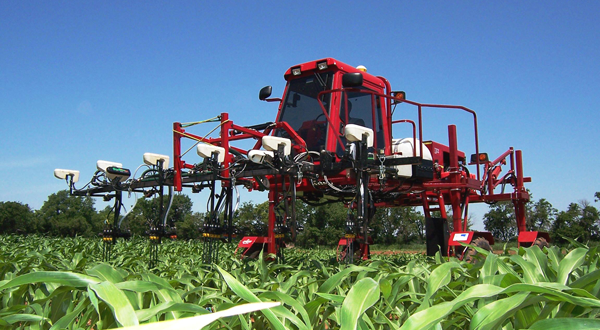
Variable Rate Spreader for Orchards: | Variable Rate Spreader for Arable Crops: |
The advantages of Variable Rate Fertilization are:
- Up to 40 percent immediate fertilizer savings have been measured
- Less fertilizer per hectare means less freight and fuel costs
- Less refiling of the fertilizer spreader
- Reduced leaching of nitrate and other soluble nutrients
- Reduced weed vigor due to lower nutrient availability
- All trees higher than about three feet can be fertilized with one spreader
- This smart technology is “green”, leading to higher efficiencies, reduced carbon emissions and lower environmental impact
- Payback of the investment in variable rate equipment is rapid, often in one season.[3]
Related Smart Farming Technology Products
Yara N-sensor[4]
Determining the right amount of nitrogen fertilizer to apply with the right timing has considerable impact on yield, protein content, fertilization cost and the environment. These precision farming tools allow farmers to adjust fertilization to the exact needs of plants at every spot on the field. The Yara N-Sensor is a tractor-mounted device. It measures light reflectance from the crop canopy in different spectral ranges. The Yara N-Tester is a handheld device used for determining nitrogen requirements by measuring the chlorophyll content of the leaf.
Related Scientific Papers and Publications
Applying more nitrogen fertilizer where it is needed increases yield and farmer profit. In the study area, only 14% of the increase in profits is attributable to increasing yields. According to the Iowa State University’s Department of Agronomy, the typical producer cost in obtaining a digitized field soil map is approximately $20. This one-time cost is negligible when spread over its useful life. The charge for variable-rate fertilizer application is $6.50 per acre versus the common $5 per acre for single-rate fertilizer application. Hence, the additional cost of moving to variable-rate technology is $1.50 per acre.[5]
The Yara N-Sensor has been demonstrated to perform well and it is assumed that N-Sensor costs 25,000 euro. It was further assumed that the sensor is fully depreciated in 5 years that it is used on 100 ha of potatoes each year and that half of its use is in other crops. Then the price per ha is 25,000/5/100/2=25 € ha-1y-1 .[6]
References
[1] Grisso, R. D., Alley, M. M., Thomason, W. E., Holshouser, D. L., & Roberson, G. T. (2011). Precision farming tools: variable-rate application.l
[3] Radite P.A.S, Hermawan W., Budiyanto B., Azis A., (2010), Development of Variable Rate Fertilizer Applicator Module Based on 8-bit Embedded System, AFITA 2010 International Conference, The Quality Information for Competitive Agricultural Based Production System and Commerce
[4] Yara N-Sensor
[5] Babcock B.A., Pautsch G.R., (1998), Moving from Uniform to Variable Fertilizer Rates on Iowa Corn: Effects on Rates and Returns, Journal of Agricultural and Resource Economics 23 (2): 385-400
[6] Van Evert F. K., Cremaschi D.G., Fountas S., Kempenaar C., (2017), Can Precision Agriculture Increase the Profitability and Sustainability of the Production of Potatoes and Olives?, Sustainability 2017, 9, 1863