
Manure Sensing [Professional]
Introduction
Manure is a nutrient-rich organic fertilizer. But until now, natural variance and rapid settling left the success of manure fertilisation to chance[1]. Optimizing the use of manure minimizes loss of nutrients and dispersion into the environment. Manure not only contains nutrients such as N, P and K which can be re-used as fertilizer in agriculture, it also contains valuable organic compounds such as proteins, amino acids, fatty acids and carbon chains, which have potential for use in the bio-based industry. Manure can also be used as a growing substrate of alternative cultivations like duckweed, algae, fungus, black soldier fly[2].
Related Smart Farming Technology Product (Manure Sensing)
John Deere Manure Sensing system[1]
John Deere Manure Sensing system continuously measures nutrient levels within liquid organic and mineral fertilizers. It collects and processes information such as: manure type, optimal nutrient level, machine location, machine ground speed, applicator width, and application flow rate. This information is used to generate a target nutrient and manure application rate. The target nutrient concentrations are applied through manual or automatic adjustments in tractor speed. While manure is being applied, selected nutrient and flow information is recorded. This process optimizes nutrient concentration while staying within regulatory requirements.
The John Deere Manure Sensing system contains the following components:
- HarvestLab™ Sensor
- Manure Sensing Control Unit (MSC)
- GPS Receiver – tractor component
- GreenStar™ Display – tractor component
- Flowmeter – tanker component
- Tanker Control Unit – optional tanker component
- Record Switch – optional tanker component
- John Deere™ Tractor Electronic Control Unit (TECU) – optional tractor component
- John Deere™ Tractor-Implement Automation (TIA) – optional tractor component
Learn about Manure Sensing:
John Deere Manure Sensing can analyse constituents not only during filling but also during application the second before the nutrients hit the soil. An invaluable advantage over other systems, as natural nutrient variances and settling during transport are taken into account and compensated with automatic real-time speed and/or flow rate adjustments. Moreover John Deere Manure Sensing data can be wirelessly sent to the John Deere Operations Center for further processing.
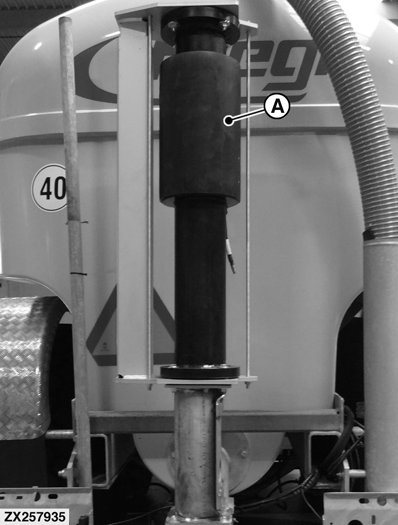
The HarvestLab™ Sensor (A) is required for nutrient concentration information. Several times per second it uses a near infrared (NIR) spectrometer to measures the nutrient composition of outgoing manure.
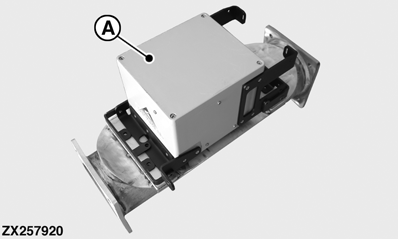
Manure Sensing Control Unit (MCS):
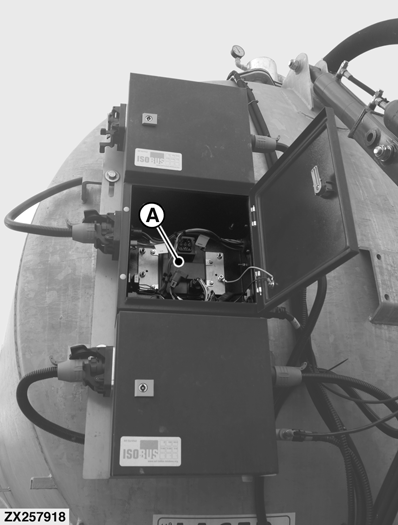
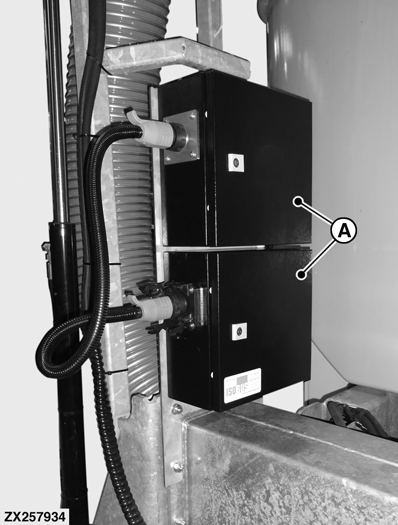
The Manure Sensing Control Unit MCS (A) is a required control unit, collecting flowmeter and nutrient sensor information. When activated by the record switch, the Manure Sensing Control Unit (MCS) sends flowmeter information to the display. The Manure Sensing Control Unit (MCS) continuously provides selected nutrient information to the display.
The Manure Sensing Control Unit (MCS) can connect to the tanker control unit. Information passes to the tanker control unit when tractor ground speed adjustments fail to reach optimal nutrient concentrations.
- On tanker with ISOBUS system, the Manure Sensing Control Unit (MCS) (A) is integrated to the tanker control boxes.
- On tanker without ISOBUS system, the Manure Sensing Control Unit (MCS) (A) is integrated to the HarvestLab™ Sensor box.
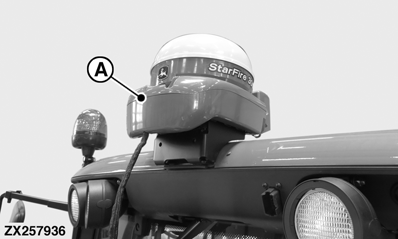
A GPS receiver (A) is required to communicate GPS information to the display and control units.
GreenStar™ Display:
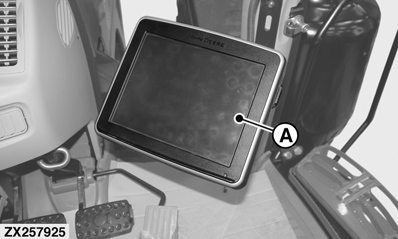
The GreenStar™ 3 2630 display (A) is required for setup, visualization, and recording of Manure Sensing data. The display is divided into active segments, used for command inputs, and inactive segments, used to display information. This setup allows various parameters (for example: area completed per unit of time, material flow per unit of time, nutrients per area, and others) to be displayed, recorded, stored, and printed.
When ignition is switched on, the GreenStar™ display (A) is supplied with voltage.
The flowmeter (A) is a required, machine provided, flow sensor. Flowmeter data allows calculation of manure and nutrient volume.
The tanker control unit (A) is an optional, tanker provided, electrical control unit. On some tankers, the tanker control unit controls the slurry flow control valve.
If tractor ground speed adjustment fails to reach optimal nutrient concentration, then the TIA routs this information to the MCS. The MCS routs this information to the tanker control unit. The tanker control unit uses this information to adjust the slurry flow control valve appropriately. Adjusting slurry flow rates maintains optimal nutrient distribution.
Record Switch – Optional:
The display receives flowmeter information only when prompted by the record switch, a required component. When machine is applying manure, a feather arm extends the applicator. When machine is not applying manure, the feather arm retracts the applicator. Contact with the feather arm triggers the record switch. The record switch signal tells the MCS to record flowmeter data.
Tractor Electronic Control Unit (TECU) – Optional:
John Deere™ Tractors route MSC and display CAN bus information through the TECU. When activated, John Deere™ ISO compatible tractors utilize this information in tractor-implement automation (TIA).
Tractor-Implement Automation (TIA) – Optional:
TIA is an optional feature that allows John Deere Manure Sensing to adjust tractor ground speed automatically. Adjusting tractor ground speed adjusts manure application rates. This automatic ground speed adjustment by the TIA automatically optimizes nutrient concentration and distribution.
So, you can:
Quantify a nutrient value of € 0.75 to € 1.50/m³, reducing mineral fertiliser input cost
Avoid down crop and gain more consistent crop growth
Maximise yield and quality while keeping legal limits
It is also, compatible with most slurry tankers and reel hose systems.[1]
Find out more about Manure Sensing:
References
[1] deere.co.uk/en/agricultural-management-solutions/precision-farming/harvestlab-3000
[2] library.wur.nl/WebQuery/wurpubs/fulltext/498084