Yield Mapping and Yield Sensors [Professional]
Introduction
Yield monitor is a device combined with other sensors that calculates and records the crop or grain yield while harvesting machines operate. Yield monitors one of the most widely used commercial products and have been available on the market for more than two decades. A yield monitor is most useful with a Positioning System (GPS) receiver, enabling the generation of yield maps that demonstrate the spatial in-field variability in productivity. Yield mapping refers to the process of collecting georeferenced data on crop yield and characteristics while the crop is being harvested. The yield maps can then be combined with historical data and result in valuable data and agronomic observations. These information can assist the optimization of farm operations scheduling and management of chemicals and fertilizers to ensure that these inputs are applied at the right amount, time and locations in the field.
Usually the monitor with the appropriate software / user interface is located in the cab of the combine or tractor. This piece of equipment serves many different purposes, although its main function is to display the information gathered by the different on-board sensors. This way the operator can monitor whether all sensors and components are operating smoothly and assists the timely detection of hardware malfunctions.
Most sensors and yield monitoring units are designed to measure:
-
- Harvest flow
- Moisture content
- Speed of the harvester
Grain yield measurement is calculated from the measured grain mass flow, the harvester speed and the header width. Moisture measurement is an important piece of the yield monitoring process, as it provides producers with additional information about spatial variability within a field and is also used to estimate dry grain mass.
Find out how the combine harvesters operate: |
|
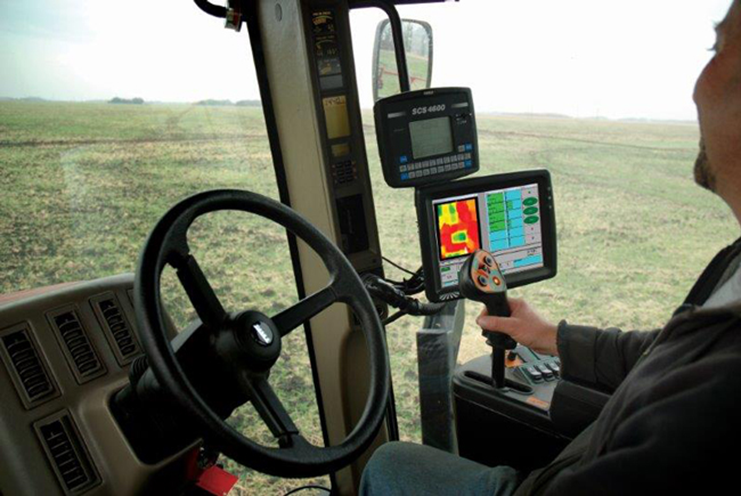 |
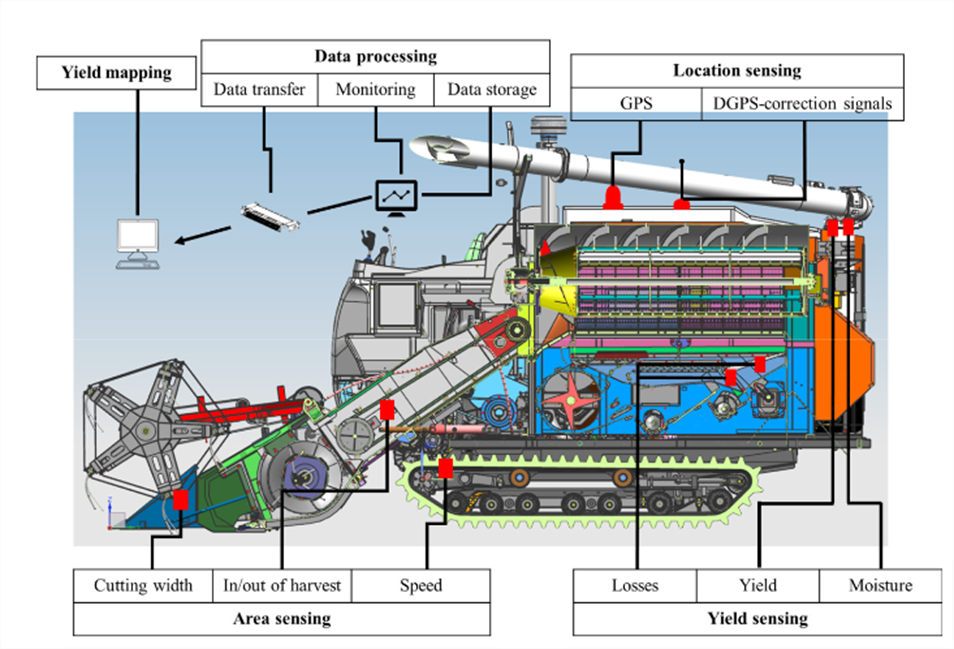
Grain crop combine harvesters cut crop plants at the header height and transport them to a threshing mechanism. Threshed crop grains fall through a separation screen to a horizontal transportation auger. Then, a clean grain elevator (or vertical auger) moves the grains and discharge to a grain bin (or tank). When the grain tank is full, the grains are discharged through a pivoted auger to a separate trailer or cargo vehicle. Grain flow sensors are mounted along the route of crop and grain transportation.
- Collect-and-weigh method that is an old and simple method. Harvested crop is manually weighed with the use of scales at a grain receiving facility or scale equipped wagons after the harvest and transport.
- Batch-type yield monitoring method. This type of yield monitors has been available especially for grains. The system weighs the grain as it is loaded to a wagon as the grain tank is unloaded.
- On-the-go yield monitoring that continuously measures and records the yield and the area as the crop is harvested. This is the most advanced method and the on Yield Monitors are used for.
Both on-the-go and batch-type methods collect and weight. Batch type method require calculation of area harvested to estimate the yield. The yield values determined by these methods are not site specific enough for the site specific management. However, they do not require much time and separate weighing operation. On the go yield monitoring is the one suitable for the PA since it measures and records both yield, area and data point positions simultaneously.[3]
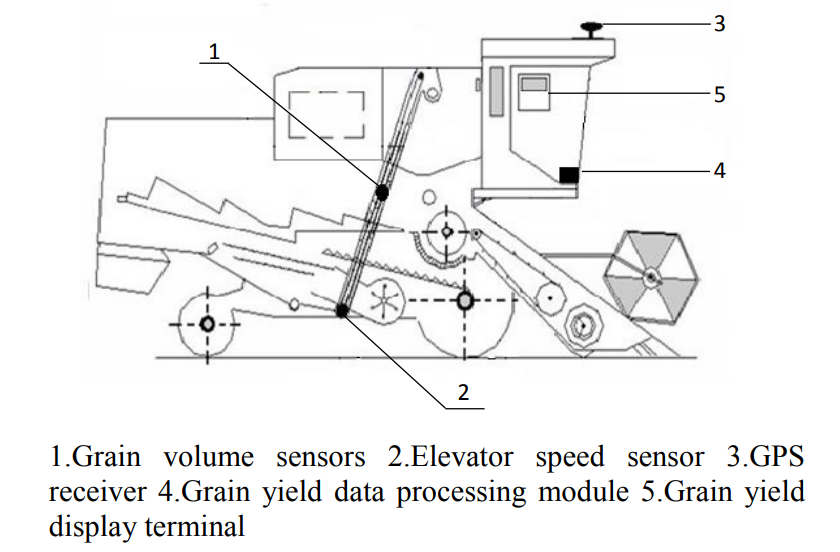
The basic components of grain yield mapping system are:
- Grain flow sensor – determines grain volume harvested.
- Grain moisture sensor – compensates for grain moisture variability.
- Clean grain elevator speed sensor – used by some mapping systems to improve accuracy of grain flow measurements.
- GPS antenna – receives satellite signal.
- Yield monitor display with a GPS receiver, geo-reference and record data.
- Header position sensor – distinguishes measurements logged during turns.
- Travel speed sensor – determines the distance the combine travels during a certain logging interval.[4]
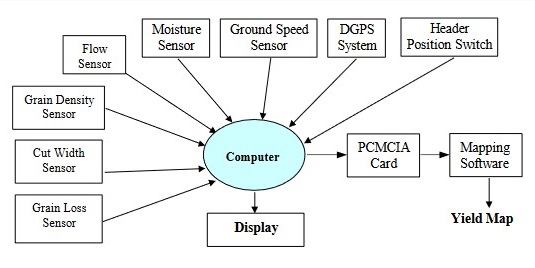
Figure 3: Schematic of the components of a yield monitoring system for a combine harvester.[5]
Before the use of a yield monitor in order to extract accurate data, a system calibration is needed. It must be performed for each type of crop harvested, especially later in the season as average moisture content drops or when there is a significant change in crop size and characteristics. The way to calibrate the yield monitor is the following:
Weighting and recording the moisture of the first several loads collected under a variety of conditions, such as various operating speeds or grain flow rates. On figure 4 there is an example the importance of calibration.
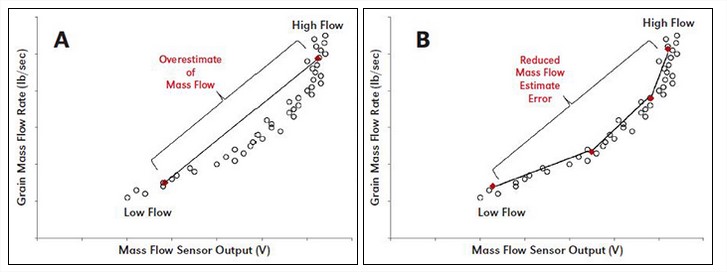
- Distance: The sensor must be calibrated by operating the combine over a known distance.
- Header height: There are principally three different methods for sensing header height. One method is a magnetic sensor that opens a contact when the header reaches a predetermined position. A second method uses a rotary potentiometer for sensing the angle or elevation of the header. At the option of the combine operator, the start and stop positions determined by the potentiometer can be adjusted on a control panel located in the combine cab. The third method involves tracking the length of time the header height control switch is in the “up” or “down” position.
- Mass-flow rate of grain: Weight grain harvested over a certain interval and then enter the actual weight of grain harvested into the yield monitor.[7]
Related Smart Farming Technology Products
Ag Leader Yield Monitoring[8]
Ag Leader provides the most widely used grain yield monitoring technology in the world. Create and view yield and moisture maps while harvesting and instantly observe how field conditions affect yield. Make year-round management decisions based on this valuable information.
- Grain is fed into the harvester’s elevator where the sensor reads the moisture content.
- As the grain is delivered to the holding tank, the mass flow sensor monitors yield.
- Information on both yield and moisture from the sensors is recorded by the Ag Leader display mounted in the cab.
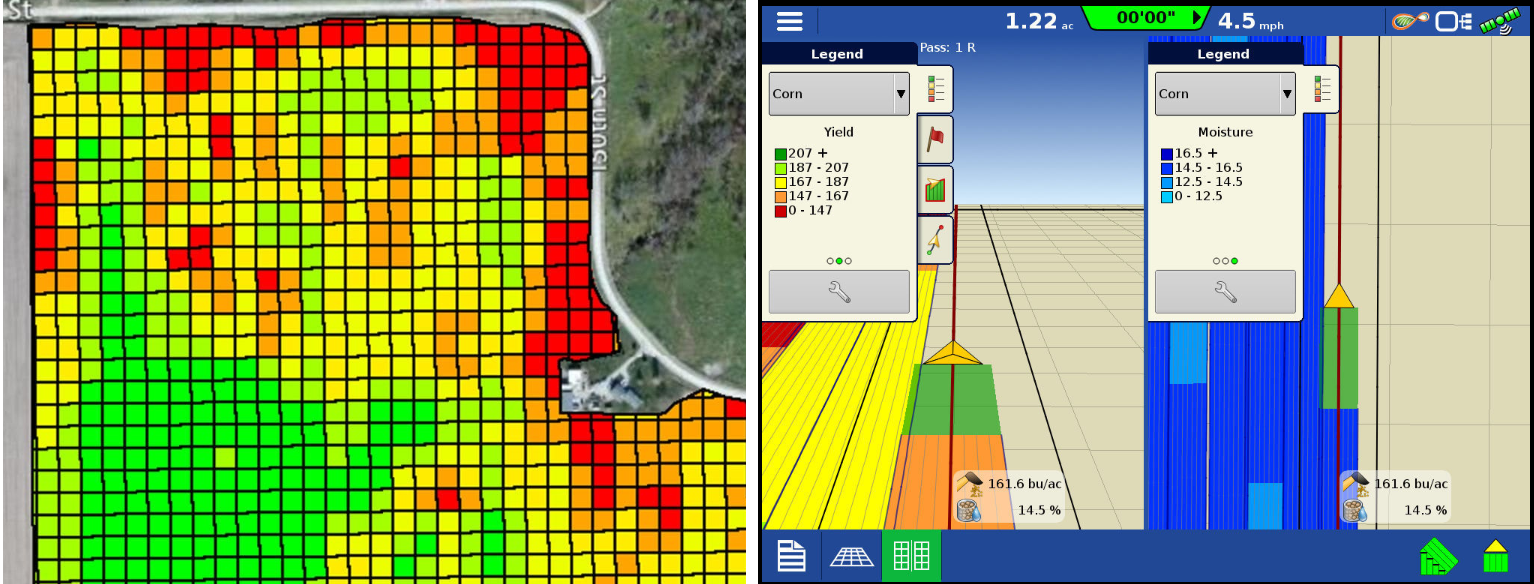
YieldTrakk provides high accuracy yield and moisture monitoring and mapping, enabling better management to maximize yield, productivity and profits. YieldTrakk works on virtually any combine and is easy to install, use, and calibrate.
- Real-time yield map views provide instant feedback
- Automatic header width control to increase yield data accuracy
- Optical sensor technology for easy installation and calibration
- Terrain compensation for more reliable yield data and mapping
- Fits on nearly every combine make and model currently available
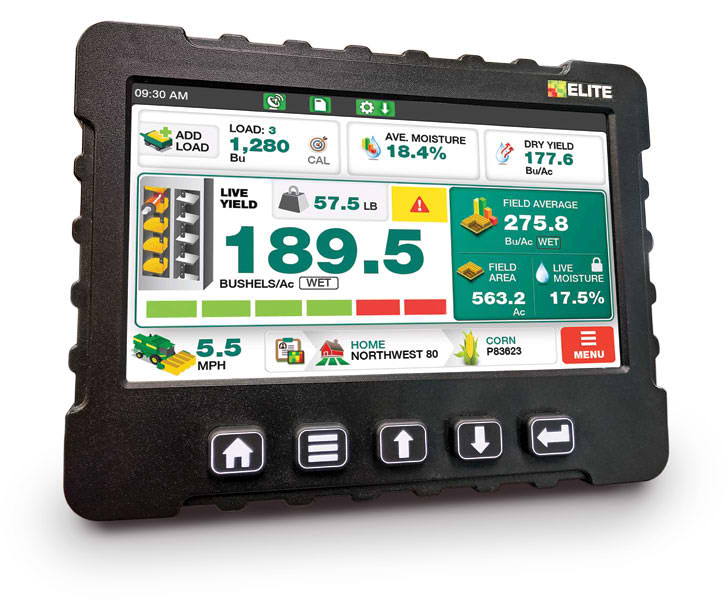
Loup Electronics Elite Yield Monitor System[10]
This yield mapping system uses optical yield sensors to collect yield information and moisture sensors to gather the crop moisture readings. A GPS receiver and data card are available to log and create field maps.
Precision Planting YieldSense[11]
YieldSense uses a flow sensor at the very top of the clean grain elevator to measure all of the crop as it comes off the paddle. Traditional flow sensors don’t measure all of the crop, and calculate yield improperly as a result. YieldSense also uses a specially shaped clean grain paddle so that the grain comes off of the paddle consistently. When grain is moving correctly across the flow sensor, variances in flow can easily be measured.
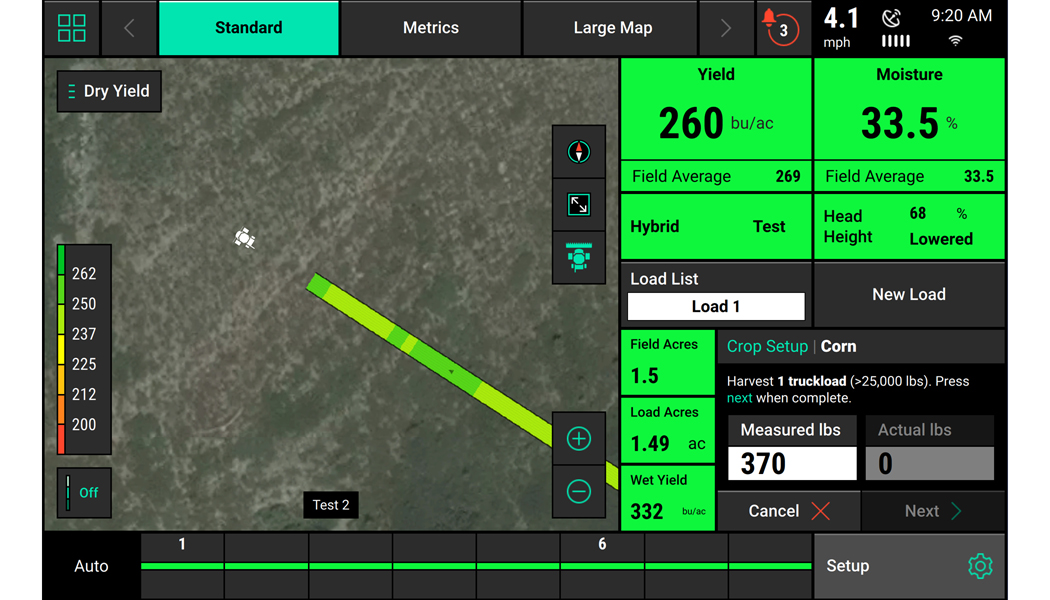
Trimble Yield Monitoring[12]
During harvest, you can accurately view, map, and record crop yield and moisture data in real-time to instantly understand how well your crop performed. With Trimble Yield Monitoring, you can map and compare the performance of different seed varieties throughout your field, and improve seed selection based on yield data over multiple years. By identifying high- and low-performance areas, farmers can determine the best seed variety for their farm, reconcile yield maps with the actual load ticket data, generate reports and allowing them to perform valuable analyses to enhance their decision making, season to season.
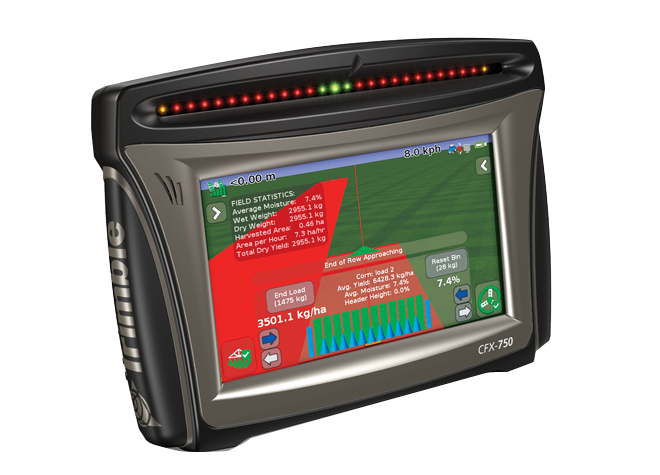
New Holland’s integrated yield sensors to Harvesters[13]
New Holland’s CX7 and CX8 range of combines are packed with yield and moisture sensors.
John Deere HarvestLab 3000[14]
The Harvestlab 3000 sensor uses near-infrared (NIR) spectroscopy to analyse various constituents within harvested crops, silage or slurry. The sensor can provide more than 4,000 measurement points per second
Related Scientific Papers
Development and performance experiment on grain yield monitoring system of combine harvester based on photoelectric diffuse reflectance[15]
In order to further improve the monitoring accuracy of grain combine harvesters, a new real-time grain yield monitoring system based on photoelectric principle was developed in this study. The system was composed of sensor module, grain yield data acquisition module, GPS module and grain yield display terminal. The sensor module included diffuse reflectance grain volume senor as key component of the system and rotating speed sensor of elevator. A model of grain mass on the scraper was established based on optical principle of photoelectric diffuse reflection effect and grain kinematic principle. Prediction model and diffuse reflectance grain yield monitoring software were embedded in the grain yield display terminal. When the elevator scraper of the combine harvester with the grain passed the diffuse reflectance grain volume sensor, the light path would be blocked intermittently. A wheat-yield in an open field experiment showed that the grain yield monitoring system based on photoelectric principle had a maximum error of only 3.51%, offering a wide range of grain feeding quantity and satisfied the need of field grain yield monitoring.
References
[1] Cargillag.ca
[2] Choi, Moon Chan & Lee, Kyu-Ho & Jang, Bo-Eun & Kim, Yong-Joo & Chung, Sun-Ok & Lee, Jong-Soon & Kim, Su-Kyeong. (2018). Grain flow rate sensing for a 55 kW full-feed type multi-purpose combine. International Journal of Agricultural and Biological Engineering. 11. 206-210. 10.25165/j.ijabe.20181105.2686.
[3] Muharrem Keskin, Young J. Han and Roy B. Dodd (1999) Review Of Yield Monitoring Instrumentation Applied To The Combineharvesters For Precision Agriculture Purposes. 7th International Congress on Agricultural Mechanization and Energy 26- 7th International Congress on Agricultural Mechanization and Energy 26-27 May 1999 Adana TÜRKİYE
[5] Sun-Ok Chung, Moon Chan Choi, Kyu-Ho Lee et al. (2016) Sensing Technologies for Grain Crop Yield Monitoring Systems: A Review
[6] Yield monitor calibration procedure
[8] AgLeader
[10] Elite Yield Monitor
[11] YieldSense
[15] Lu Changhua, An Xiaofei, Ding Hai, Fu Weiqiang, Li Liwei, Wu, Qiulan, Meng Zhijun (2018) Development of combine grain yield monitor system with self-feedback function. IFAC-PapersOnLine Volume 51, Issue 17, 2018, Pages 408-411