
Autoguided computer vision system for row and weed detection [Professional]
Introduction
Computer vision is an interdisciplinary scientific field that deals with how computers can be made to gain high-level understanding from digital images or videos. From the perspective of engineering, it seeks to automate tasks that the human visual system can do.[1][2][3]
In agriculture computer vision can be used for procedures such as row and weed detection.
Related Scientific Article
Crop rows and weeds detection in maize fields applying a computer vision system based on geometry[4]
This paper proposes a new machine vision system, focused on crop row detection with three main goals:
- to achieve a correct orientation at the starting point in the field for each path;
- to achieve a precise guidance during path following and
- to determine the weed density and overlapping.
The vision system is designed to be installed onboard a mobile agricultural vehicle, i.e. submitted to turns, vibrations and undesired movements. The images are captured under image perspective projection, being affected by the above undesired effects. To achieve the above goals, we have designed an image processing strategy comprising two main modules: (a) crop rows detection with precise adjustment and (b) data extraction for determining weeds densities for site specific-treatments, guidance and the overlapping of the area where the treatment is to be applied. Both modules form a full process, and each module contains different processes, some of them coming from existing approaches (image segmentation and crop row estimation with adjustment) and other specifically designed for the proposed approach (exposure time control, position and orientation of the tractor and weeds density matrix computation with overlapping control).
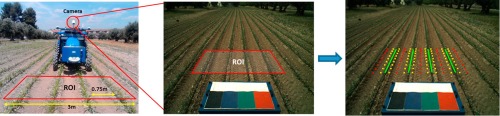
The proposed strategy has been conveniently tested and also the different processes defining each module, verifying their performances in terms of accuracies and processing times. Comparative analyses have also been carried out against some existing processes, also with acceptable performances.[4]
References
[1] Dana H. Ballard; Christopher M. Brown (1982). Computer Vision. Prentice Hall. ISBN 978-0-13-165316-0
[2] Computer Vision : Evolution And Promise (PDF). 19th CERN School of Computing. Geneva: CERN. pp. 21–25. doi:10.5170/CERN-1996-008.21. ISBN 978-9290830955
[3] Image Processing, Analysis, and Machine Vision. Thomson. ISBN 978-0-495-08252-1
[4] José Miguel Guerrero, José Jaime Ruz, Gonzalo Pajares (2017), Crop rows and weeds detection in maize fields applying a computer vision system based on geometry. Computers and Electronics in Agriculture, Volume 142, Part A, Pages 461-472, ISSN 0168-1699.