Soil Electrical Conductivity Sensors [Student]
Introduction
Accurate soil water content measurements are critical for estimation of energy and water balances, as well as for understanding chemical and biological processes in vadose zone, plant root zones and in groundwater.[1] Soil electrical conductivity is an indirect measurement that correlates very well with several soil physical and chemical properties. Electrical conductivity is the ability of a material to transmit an electrical current and it is commonly expressed in units of mS/m (milli-Siemens per meter).
It is an important parameter because it correlates very strongly with particle size and soil texture. It also correlates with cation exchange capacity (CEC), drainage conditions, organic matter level, and salinity and subsoil characteristics.[2] In soils, materials in the pore can be conductive such as water and dissolved salts.
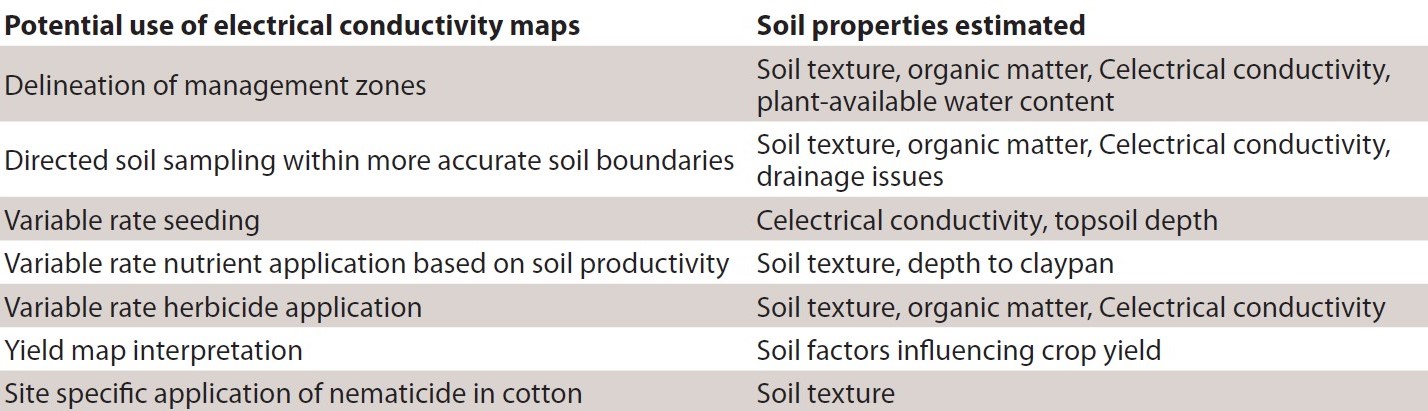
The agricultural uses for soil ECa
- Delineation of management zones (variable rate seeding, nutrients, herbicides, irrigation)
- Directed soil sampling and other on-farm tests
- Interpretation of yield maps
- Fine-tuning soil maps
- Salinity diagnosis
- Drainage remediation planning[3]
Measurements of Soil Electrical Conductivity can be affected by the following factors:
- Soil texture (clay content and mineralogy, porosity, cation exchange capacity CEC, compaction, depth to hardpan).
- Water content (texture-water holding capacity).
- Salinity level (dissolved salts).
- Temperature (EC increases as temperature increases).[3]
Smart Farming Technology Products
There are two types of ECa Sensors:
- Contact: they use electrodes and measures voltage, Veris (Veris Technologies, Inc., Salina, Kansas USA)
- Non-Contact: sits up or above the soil surface and measures electromagnetic inductance, EM38 (Geonics Ltd., Mississauga, Ontario, Canada)
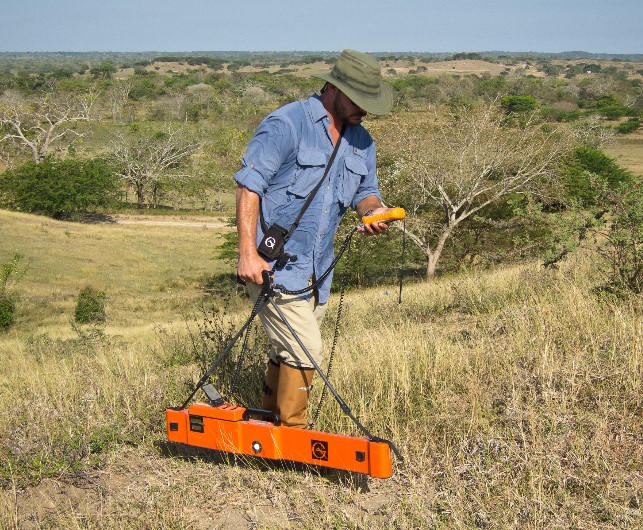 | 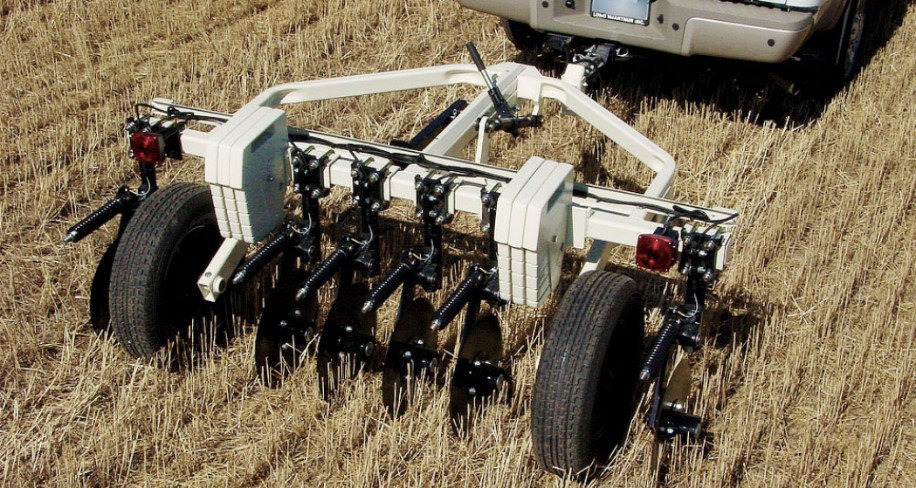 |
Figure 1: Electrical Conductivity EM38 Sensor.[5] | Figure 2: Electrical Conductivity Veris Sensor.[6] |
The contact sensors usually measure soil electrical conductivity in two different depths, shallow (0.3 m) and deep (1 m).
It is really important to have soil electrical conductivity measurements, because it helps to understand the soil texture and type. Soil texture relates to factors that have a major impact on productivity and will affect management strategies. For example, irrigation scheduling is closely related to soil type and water holding capacity of the soil, mobile nutrients used, lost and stored differently as soil texture varies.[4] The use of EC measurement systems is nowadays of great importance for irrigation, crop and fertilizer management in a framework of precision agriculture (PA).[7]
These instruments are worth between 12,000 and 24,000€ and integrate global positioning system (GPS) and data-logging utilities. The EM-38 sensor is the simplest instrument, in which there are just one transmitting and one or two receiving coils 1 m apart and are worth between 11,000 and 14,000 €. As a consequence, these instruments are sensitive to the soil ECa down to depth between 0.5 and 1.5m, which is where most plant’s roots develop and thus, the most interesting for soil studies and agriculture. Electromagnetic induction, provides the possibility of obtaining high resolution images of ECa is such a proxy, providing a measure of charge mobility due to application of an electric field and water content.[8]
The VERIS uses rolling coulter electrodes to directly sense soil electrical conductivity.[9]
When the sensor is laid onto the soil, 70% of the cumulative sensor signal is provided by the upper 1.55m in the vertical orientation and by the upper 0.75 m in the horizontal orientation (Visconti F. and de Paz J.M., 2016).[10]
According to studies (Sourell H., Hezarjaribi A., 2007), there is a big difference between EM38 and Veris readings. It was showed (after a comparison between these measurements) that, while qualitatively similar ECa data obtained with different commercial sensors were quantitatively different.[11]
Veris sensor: | EM38 sensor: |
References
[1] Kizito F., et al., (2007), Frequency, electrical conductivity and temperature analysis of a low-cost capacitance soil moisture sensor, Journal of Hydrology 352, 367-378
[2] Grisso B. R., et al., (2009), Precision Farming Tools: Soil Electrical Conductivity, Virginia Cooperative Extension, publication 442-508
[3] agric.gov.ab.ca/$Department/deptdocs.nsf/all/crop14324/$FILE/au-2013-woods-effectiveness-of-em38-and-veris-soil-ec-technologies.pdf
[4] Wietrak P., Khalilian A., /Mueller J., Henderson W., (2009), Applications of Soil Electrical Conductivity in Production Agriculture, Better Crops, Vol. 93 No.2
[5] geoviewinc.com/case-studies/archaeological-studies/pre-colombian-artifacts
[6] veristech.com/the-sensors/v3100
[7] What is soil Electrical Conductivity, LSU AgCenter Pub. 3185
[8] Abdu H., (2009), Characterizing subsurface textural properties using Electromagnetic Induction mapping and geostatistics, Utah State University, Doctor of Philosophy Thesis, pages 3
[9] K.A. Sudduth, N.R. Kitchen, W.J. Wiebold, W.D. Batchelor, G.A. Bollero, D.G. Bullock, D.E. Clay, H.L. Palm, F.J. Pierce, R.T. Schuler, K.D. Thelen (2005), Relating apparent electrical conductivity to soil properties across the north-central USA, Computers and Electronics in Agriculture.
[10] Visconti F., de Paz J.M., (2016), Electrical Conductivity Measurements in Agriculture: The Assessment of Soil Salinity, InTech, Chapter 5, pages 99-126
[11] Hezarjaribi A., Sourell H., (2007), Feasibility study of monitoring the total available water content using non-invasive electromagnetic induction-based and electrode-based soil electrical conductivity measurements, Irrigation and Drainage 56: 53-65