
Variable Rate Fertilization [Professional]
Introduction
Applying fertilizer is a common agricultural activity that can be completely automated with the correct implementation of Variable Rate Fertilization (VRF). There are two main categories in which VRT fertilization can be applied: 1) with a map of a certain parameter such as crop vigor and 2) with real time sensors.
Map-based VRF adjusts the application rate based on a digital map, also called a prescription map. For example, to develop a prescription map for VRF in a particular field, the map can be develloped based on several parameters such as:
- Soil attributes
- Crop growth and vigor
- Elevation
- Historical yield data
After the prescription map is loaded on the fertilizer, a positioning system is used during the application step to record location of the each point in the field and to apply the prescribed fertilizer rates in the appropriate areas of the field.
Sensor-based VRA requires no map or positioning system. Sensors on the applicator measure soil properties or crop characteristics “on the go.” Based on this continuous stream of information, a control system calculates the input needs of the soil or plants and transfers the information to a controller, which delivers the input to the location measured by the sensor.
VRA increases your economic return by strategically optimizing inputs in each management zone. VRA allows you to focus inputs on management zones that provide the highest return, while reducing inputs in lower productivity zones or where previous management has resulted in a situation for reduced input need.[1]
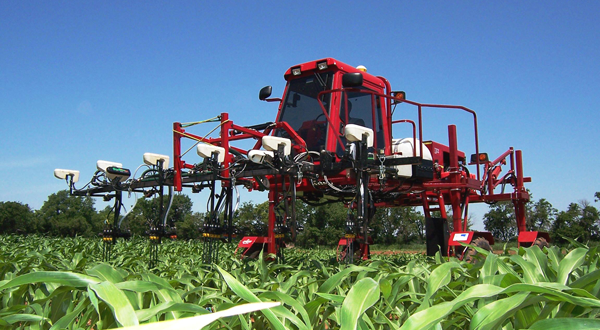
Variable Rate Spreader for Orchards: | Variable Rate Spreader for Arable Crops: |
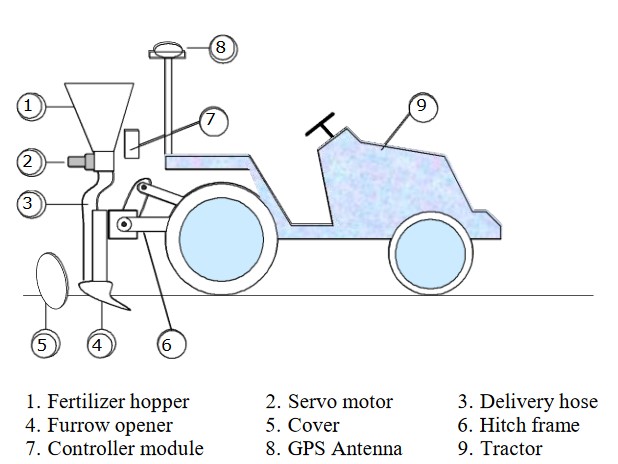
The components of the VRT fertilizer applicator are:
- Variable Rate Controller: is a host PC
- Fertilizer bin made with stainless steel because of its strength and resistance to corrosion
- Rotary valve: it rotates according to the required application rate of the fertilizer will be used as a metering device
- Centrifugal turbo blower
- Discharge chute
At the start of the operation on each block, the fertilizer discharge chutes are set to the right length according to the distance of throw required for the each block. The bin is filled with the type of fertilizer to be applied. The generating set is switched on. Then, the valves of the hydraulic motors of the centrifugal blowers are actuated to put them on. There is a toggle switch placed inside the discharge duct of the fertilizer bin. The toggle switch only switches on the valve of the hydraulic motor of the screw conveyor when the discharge duct is not filled up to a pre-set level. The fertilizer bin is also equipped with a web cam that displays the condition inside the bin on the host PC at the operator’s cabin.[3]
- Up to 40 percent immediate fertilizer savings have been measured
- Less fertilizer per hectare means less freight and fuel costs
- Less refiling of the fertilizer spreader
- Reduced leaching of nitrate and other soluble nutrients
- Reduced weed vigor due to lower nutrient availability
- All trees higher than about three feet can be fertilized with one spreader
- This smart technology is “green”, leading to higher efficiencies, reduced carbon emissions and lower environmental impact
- Payback of the investment in variable rate equipment is rapid, often in one season.[5]
Related Smart Farming Technology Products
Yara N-sensor[6]
Determining the right amount of nitrogen fertilizer to apply with the right timing has considerable impact on yield, protein content, fertilization cost and the environment. These precision farming tools allow farmers to adjust fertilization to the exact needs of plants at every spot on the field. The Yara N-Sensor is a tractor-mounted device. It measures light reflectance from the crop canopy in different spectral ranges. The Yara N-Tester is a handheld device used for determining nitrogen requirements by measuring the chlorophyll content of the leaf.
Related Scientific Papers and Publications
Applying more nitrogen fertilizer where it is needed increases yield and farmer profit. In the study area, only 14% of the increase in profits is attributable to increasing yields. According to the Iowa State University’s Department of Agronomy, the typical producer cost in obtaining a digitized field soil map is approximately $20. This one-time cost is negligible when spread over its useful life. The charge for variable-rate fertilizer application is $6.50 per acre versus the common $5 per acre for single-rate fertilizer application. Hence, the additional cost of moving to variable-rate technology is $1.50 per acre.[7]
The Yara N-Sensor has been demonstrated to perform well and it is assumed that N-Sensor costs 25,000 euro. It was further assumed that the sensor is fully depreciated in 5 years that it is used on 100 ha of potatoes each year and that half of its use is in other crops. Then the price per ha is 25,000/5/100/2=25 € ha-1y-1 .[8]
According to a farmer’s statement the amount of N fertilizer he intended to apply in the particular field was 41 kg (about 82 kg/ha). Due to the variable rate application of the fertilizer the total amount of nitrogen that finally applied was 17.7 kg, meaning a reduction of 43% in the use of N-fertilizer. More over the application of the site-specific N-fertilizer improved the production capacity of the trees which had a minimum production the previous year, where the minimum kg per five trees in the year 2011, 52 kg were doubled the following year, 104 kg whereas the maximum production capacity almost didn’t change.[9]
Essentially, a VRT fertilizer applicator consist of a Geographic Information System (GIS) fertilizer prescription map, Global Positioning System (GPS) device, a volume or mass flow sensor for the fertilizer rate controller, an actuator valves and a microcontrollers or embedded computer program. Fertilizers Prescription maps which indicates fertilizer requirement are generated from yield maps, soil maps, crop nutrient levels, aerial images or maps of soil electrical conductivity. The GPS position coordinates is indicated by the GPS device. Upon a user command, the microcontrollers or embedded computer program reads the GPS coordinates, calculates the correct application rate through a formula or algorithm with reference to the prescription map, translates the correct rate into actual fertilizer output through the actuators or valves (Wittry and Mallarino, 2004).[3]
When the geometrical averages were computed, the overall net revenue at the field scale was only 849 €/ha under uniform N management, while it reached 861 €/ha under variable N management. In other words, Site Specific Management offered a +1.36% increase in net revenue per hectare.[10]
Another important fact is that N use can be reduced 15% on average without affecting yield or quality. The externally pesticide toxicity is reduced most by using variable rate application of fungicides for late blight control: this reduces environmental cost from 82 € ha-1 to 73€ ha-1 (an 11% reduction). The externality GHG emissions is reduced by variable rate application for side dress N (SN) from 136 € ha-1 to 124 € ha-1 (a 9% reduction). Profit is increased by variable rate application of herbicides (11%) but the other precision agriculture techniques.[8]
References
[1] Grisso, R. D., Alley, M. M., Thomason, W. E., Holshouser, D. L., & Roberson, G. T. (2011). Precision farming tools: variable-rate application.l
[3] Ishola, Tajudeen Abiodun and Yahya, Azmi and Mohamed Shariff, Abdul Rashid and Abd Aziz, Samsuzana (2012) Variable rate technology fertilizer applicator for oil palm plantation. In: International Conference on Agricultural and Food Engineering for Life (Cafei2012), 26-28 Nov. 2012, Palm Garden Hotel, Putrajaya. (pp. 520-534).
[4] Radite P.A.S, Hermawan W., Budiyanto B., Azis A., (2010), Development of Variable Rate Fertilizer Applicator Module Based on 8-bit Embedded System, AFITA 2010 International Conference, The Quality Information for Competitive Agricultural Based Production System and Commerce
[5] A.W. Schuman and H.K. Hostler (2008). Variable rate fertilization – getting started. Citrus Industry, January 2008
[6] Yara N-Sensor
[7] Babcock B.A., Pautsch G.R., (1998), Moving from Uniform to Variable Fertilizer Rates on Iowa Corn: Effects on Rates and Returns, Journal of Agricultural and Resource Economics 23 (2): 385-400
[8] Van Evert F. K., Cremaschi D.G., Fountas S., Kempenaar C., (2017), Can Precision Agriculture Increase the Profitability and Sustainability of the Production of Potatoes and Olives?, Sustainability 2017, 9, 1863
[9] Vatsanidou A., Fountas S., Nanos G., Gentos T., (2014), Variable Rate Application of Nitrogen Fertilizer in a commercial pear orchard, Fork to Farm: The International Journal of the American Farm School of Thessaloniki Vol. 1
[10] Basso B., Dumont B., Cammarano D., Pezzuolo A., Marinello F., Sartori L., (2016), Environmental and economic benefits of variable rate nitrogen fertilization in a nitrate vulnerable zone, Science of the Total Environment 544, 227-235