
Variable Rate Seeding-Planting [Professional]
Introduction
A Variable Rate Seeder is a seeder that has the ability to apply different seeding rates according to prescription map. The VR Seeder incorporates with positioning systems, for prescription map based application, in order to increase or decrease the seeding rate through automatic control of seeding discs, achieving yield increase by planting the exact number of seed per hectare that the soil can support[1], [2], [3].
Variable Rate Seeding matches the seed population to the various management zones of the field. With the hydraulic driven planters, farmers can change the seeding rate from inside the cab, altering the rate or the hybrid from one field to the next. On this way they take advantage of the variability.[4] Except from the soil type, environmental factors should be taken into consideration, when determining how many seeds to plant. Soil zones with higher productivity would have a different seeding rate than those with lower productivity. Another example could be that, an area prone to flooding might receive less seed and fertile area might receive more to make up for it.[5]
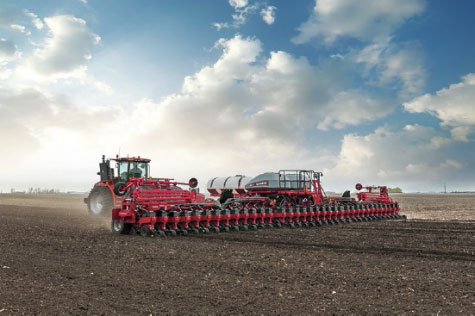
Variable Rate Seeding is accomplished by separating or disconnecting the planter’s seed-meter systems from the ground drive wheel. By attaching a motor or gear box (to change speed of the ground wheel input), the seeding rate can be varied on the go. Most of this devices will be matched with a prescription map and can have two or more rates. A two-rate scenario may be a system that reduces the seeding rates outside of the reach of an irrigation system, while multiple rates may be needed to adjust for soil types (water-holding capacity) and organic matter.[6]
| VR Corn Planting: | Variable Rate Seeding in Operation: | VR seeding New Technologies: |
Smart Farming Technology Products
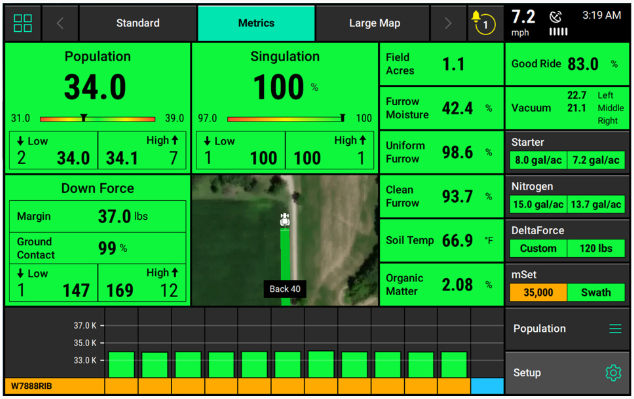
Precision Planting 20|20[7]
This product can be utilized as a monitor to help you simply set the planter to maximize planter perfomance in each crop, each day of planting, providing accurate data to make required to make crucial decisions, but also gives the equipment the powerful automation to make decisions as it passes through the field, optimizing every pass.
References
[2] Agphd.com
[3] IPF-AF.com
[6] Grisso R., Alley M., Holshouser D., Roberson T. G., (2011), Precision Farming Tools: Variable – Rate Application, Virginia Cooperative Extension, pages 442-505